by June Lovelace
Growing up in the plains states was not easy for any family, especially rural
farming/ranching families during the Dust Bowl days. People tried various
ways to make enough money to keep their homesteads afloat. This made
young people dream big dreams of how they would go off to the big cities, and
earn big bucks to make life easier for folks back home.
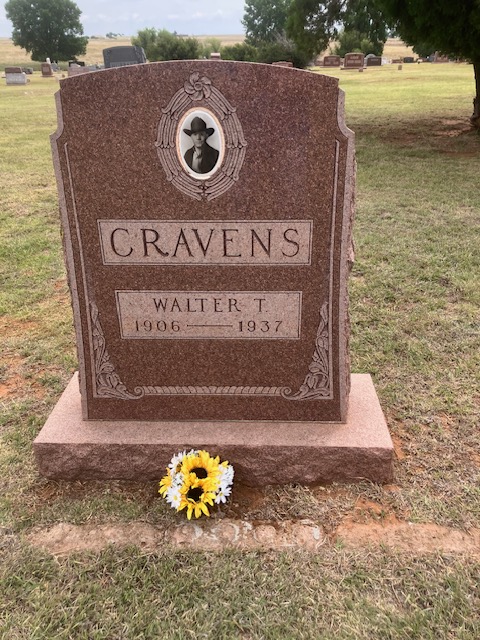
Thus, this is exactly what one young boy did: Walter Thurman Cravens,
born in 1906 near Butler, Oklahoma. He started riding livestock around the
age of twelve, in local and area rodeos where he found himself being very
successful. He rode in the Hinton rodeo many times. Earlier in 1937, he won the steer riding
contest in Amarillo. Several years before, he entered a rodeo in London, England, and placed in
competition with leading cowboys from all over the world.
Craven, star at many state rodeos and the 1935 runner-up for the world’s steer riding championship at Madison
Square Garden, was gaining fame. He came near death when a horse
threw him into a fence at Cheyenne, Wyoming. He was high man at the
livestock show at Ft. Worth the previous year.
On a Saturday night, October 9, 1937, Cravens was riding in Madison
Square Garden before a crowd of 1,300 spectators when Al Frazin, the
Garden announcer, informed the listeners that the next and last steer rider
of the evening would be Walter Cravens of Butler, Oklahoma, coming out of
Chute 9. The light atop the chute glowed, drawing the attention of the
watchers to the next point of action as Walter eased down onto the back of
the 1,300 pound Brahma bull, took hold of his rope, pulled
down his hat, signaled the gate men, and yelled, “Lemme have ‘im!” Some of the
Brahmans can’t be ridden by any man. Walt was a real steer rider. He
rode the Brahman a good twenty feet out into the arena. The steer bounded
into the air, “sunfishing” with all four feet off the ground. The third leap
when the bull was about halfway up sent Cravens flying from his seat.
The bull apparently kicked him while in the air in the back and right side
and stomped all over him before any of the six or eight boys stationed
around for just a thing could get that bull away. He managed to rise and
get away from it by climbing the chute gate but collapsed when he stepped
to the ground. Five ribs were fractured and the right lung punctured. Dr.
H.O. Clauss, head of the Garden medical staff, sent the injured cowboy to
the Polyclinic Hospital where he died of internal hemorrhages at 11:50 a.m.,
Sunday, Oct. 10, 1937. Cravens had appeared in five other rodeos at the
Garden. Walter had been kicked by a steer at an Oklahoma City rodeo recently
but was not seriously injured. He died at the age of 31, being a veteran of
rodeo for nineteen years.
Many youngsters found it hard to comprehend that laughing Walter Cravens, their riding and
roping hero, had ridden to “The Last Round-Up” and that they would never see him mounted
on “Slim”, his favorite bay, again.
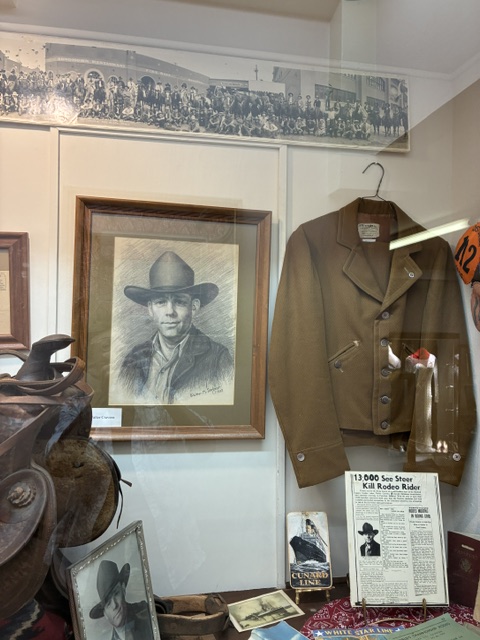
The family still has memorabilia of Cravens’ glory days including the Western Union Telegram to
the Elk City Office informing Mrs. Cora Barnard of the death of her son. Elk City’s Old Town
Museum has a nice display commemorating his life.
On the following Tuesday night, after a rodeo performance, spectators were
barred, and about 350 fellow performers, among them Eddie Curtis, his
brother Andy Curtis, “Shorty” Hill of New Mexico, and Milt Moe held Cravens’
funeral. Cravens’ best friends trooped on foot past his casket in which
Cravens’ body lay clad in cowboy regalia. A cowboy quartet sang, “The
Last Round-Up,” “Nearer My God To Thee,” and his favorite, “Moonlight and
Roses.” Dr. Nathan A. Seagle, rector of St Stephens Episcopal Church,
officiated.
A collection among the cowboys netted some $400, which was sent to the
relatives in Oklahoma. For as Eddie said, “Cowboys can’t get insurance,
and the Cravens family is going to need something to take the place of the
$5,000 a year he earned in prize money.” Cravens’ body went home
by rail to Clinton for burial in Butler, Oklahoma, accompanied by his best
friend, Eddie Curtis. Madison Square Garden and friends bought his coffin,
paid for shipping, and funeral and burial expenses.
Services were held at Pie Flat School auditorium, four miles east of
Hammon, on Sunday, October 17 at 2:00 p.m. , and burial was
in the Butler Cemetery. Some were concerned that the 400-seat auditorium might
not seat all that came to pay their respects for Walter Cravens. A. J.
Pinkerton, minister of the Hammon Church of Christ conducted the
services with music arranged by Mrs. Stanley Ray and included
the number, ”Empty Saddle.” Jake Beulter was one of the
pallbearers.
He was survived by his stepfather and mother Mr. W. L. and Cora Cravens
Barnard of Butler; one brother, H. H. Cravens of Westwood, California; five
sisters, Mrs. Lee Creach and Mrs. Viola Bobbitt of Clinton, Mrs. Gladys Hall
of Butler, Mrs. Hester of Leedey and Mrs. Ruth Ashley of Thomas; and a half-brother, Jack Barnard of Butler.