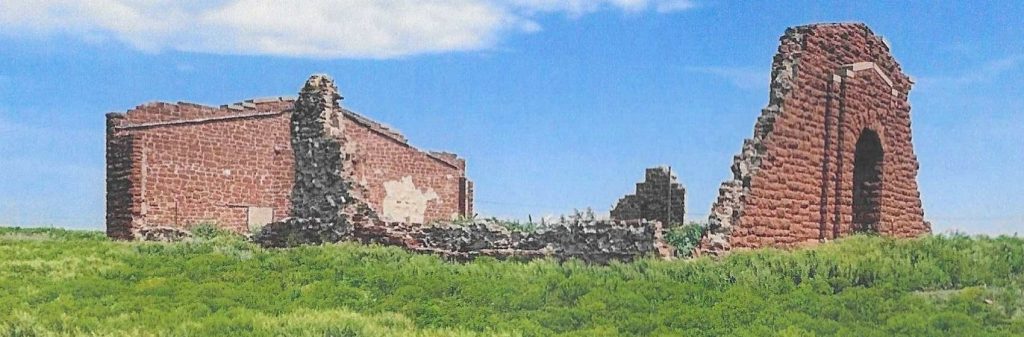
Located between Hammon and Butler, public school district number 41, known as Pie Flat was established in 1900. Public schools in Cheyenne-Arapaho country came about as a result of the Organic Act of 1890, which designated two sections in each township of Oklahoma Territory for public schools. Until that time, if children attended school, they went to subscription, mission, or tribal schools. Subscription schools were the most common and were not free. Parents paid a teacher who was responsible for all expenses of the school, even the meeting place. Subscription schools sometimes met in dugouts or tents.
Most schools were named for the families whose land they inhabited or for nearby geographic features; however, Pie Flat’s name came about in a unique way. According to the book Texas and Southwestern Lore edited by J. Frank Dobie, when the Cheyenne-Arapaho Territory was opened for settlement, a family named Nealy staked a claim, which they referred to as Nealy Flats. The family consisted of an elderly woman and her married sons and daughters. The family had milk cows and hens and as a result plenty of milk and eggs. The daughters became known for their custard pies. They also did laundry for folks. Cowboys in the area would take their shirts to be laundered and discovered that if they picked up the clean shirts on Sunday, they could also get a custard pie. The pies became so popular that the cowboys dubbed the homestead “Pie Flat.”
Another story gives a different account of the naming of the school. According to local legend, after the school was built, the community had dinner on the grounds to celebrate. Ladies brought several pies and left them cooling outside. A storm suddenly blew in, and the people hurried inside the school. After the storm, everyone came back outside and observed that the pies had survived the storm but were all flat, so they named the school Pie Flat. Regardless of how it got its name, Pie Flat School has a colorful and distinguished history.
The August 7, 1902, edition of the Custer County News reported that District Number 41 had sixty-four students. The article lamented the fact that the school would have only four months of school. Apparently some taxpayers were not in favor of public schools. Then on June 11, 1909, the Arapaho Bee reported on an effort to pass a $4,000 bond to build a school building in District 41. The newspaper did not seem optimistic about the bond passing. An article in the May 13, 1910, Butler Herald referred to the District 41 school as Mount Pleasant but said it was commonly called Pie Flat. The school continued to be called Mount Pleasant until sometime in 1911. The Hammon Advocate on December 14, 1911, said “Pie Flat School is moving along handsomely. The spirit of the school and community is [sic], and everything points to a very successful term.” Henceforward, the school was referred to as Pie Flat.

Pie Flat School became an active school with great pride. One of the activities that received attention was the debate society. The society met each Friday afternoon, and the first issue for debate was “that city life has more advantages than country life.” Another issue debated was “Columbus deserves more honor for discovering America than Washington for defending it.”
Apparently Hammon School was a rival of Pie Flat. An article entitled “Pie Flat Number One” appeared in the March 7, 1912, edition of the Hammon Advocate. The article was written by students and said, “The lure of the golden Hammon has lost its seductiveness, and Pie Flat is coming into her own.” The article went on to say, “You of the Hammon School regret the Pie Flat School is so far ahead of you.” The statement sounded like a taunt or a dare.
Pie Flat School was certainly thriving, so much so that the October 13, 1916, issue of the Arapaho Bee reported plans to “build a new $4,000 school house in the southeast corner of a section just west of the Smallwood farm” The building was to be “fully equipped in every respect.” The new school was built, but twelve years later, tragedy struck. The Februry 2, 1928, edition of the Custer County Chronicle reported that fire destroyed Pie Flat School. The article went on to say, “The Pie Flat district is well known among rural school districts in the state, having the highest rating among the rural schools in the community and second highest in the whole state.” The article also reported that authorities had not determined the cause of the fire. According to the Butler Herald, Pie Flat School would continue classes in the Red Moon Indian School, which closed in 1925. Even in the face of tragedy, Pie Flat was undaunted; the Custer County Chronicle reported on June 14, 1928, that Pie Flat had an 87% attendance record for the school year.
Meanwhile the Samsville School closed at the end of the 1928 school year and consolidated with Pie Flat during the rebuilding of the school. The new school opened in September 1928, and the Custer County Chronicle reported that the new school had six classrooms, an auditorium, and a basement. The principal and seven teachers would be offering twelve full years of education. A picnic dinner was held in celebration of the new school building.
Spirits continued high at Pie Flat. The Custer County Chronicle reported that the school hosted a pie supper to celebrate Christmas. The students raised $145 for Christmas treats, and they awarded various prizes. “Miss Juna Long got the cake for being the most popular young lady at the pie supper. Lois Minich and Leonard Taylor got the rolling pin for being the most love-sick couple. John Allen got the jar of pickles for the homeliest man.”
Among the activities available to Pie Flat students was 4-H Club. Custer County boasted 500 members with 45 from Pie Flat. A countywide meeting was held, and Pie Flat’s 4-H president, Albert Trent, attended.
The community support for the school was outstanding. Patrons furnished funds for a “$400 storm cave” according to the April 4, 1929, issue of the Butler Herald. The patrons again showed their support for the school when it held its first graduation. Two students were in the graduating class: Eugene Burgess and Leonard Trent.
Pie Flat School continued to thrive despite the ongoing Depression. By 1935, the school was performing plays and had an undefeated basketball team. In 1936 the district purchased five school buses to cover its 60 square miles and 22 additional square miles outside the district. The high school offered a full range of classes including home economics and industrial arts.
The November 9, 1941, edition of the Clinton Daily News reported that Pie Flat School again experienced destruction by fire. The $30,000 high school building burned, destroying everything except school records and a typewriter. A neighbor spotted the fire at 3:00 a.m. The grade school building was not harmed. School was not in session at the time of the fire as students had been dismissed for cotton harvest. Investigators found an anti-freeze can near one of the windows and surmised that it had been used to spread flammable liquid. Arson was suspected.
The December 3, 1941, issue of the Clinton Daily News noted that school at Pie Flat would resume the Monday after the fire. The fifty-five high-school students would attend classes in the grade-school building, and one of the teacherages would be converted into classrooms for the grade-school students crowded out of their rooms.
During the aftermath of the Pie Flat School fire, the Japanese bombed Pearl Harbor on December 7, 1941, and the United States went to war. The Pie Flat students lent a hand to the defense campaign. The Clinton Daily News reported on February 1, 1942, that the students held “a contest in the sale of defense bonds and stamps, and when it was all over, they had $2,075.50 invested in America and the nation’s defense program.
With America at war and young men enlisting in the military, the investigation into the fire dwindled. Some people have conjectured that the culprit could have joined the military to avoid paying for his crime. Other people at the time of the fire noted that there had been friction in the district over moving the school a mile east after the first fire. Nevertheless, the Pie Flat School fire of 1941 remains an unsolved crime.
The class of 1942 bravely finished their senior year and were the last graduates of Pie Flat. The rest of the students went to Hammon and Butler schools the next school year, and the remaining Pie Flat School building sat empty. The ghostly remnants of the long extinct Pie Flat School sit forlornly in the middle of a pasture a few miles east of Hammon, a haunting reminder of days gone by.